EV
Mitsubishi revives ASX for EV era
Mitsubishi is bringing back the ASX name for a new battery-electric model in Australia, where the 2027 ASX VR-e is scheduled to arrive in showrooms in the fourth quarter of 2026.
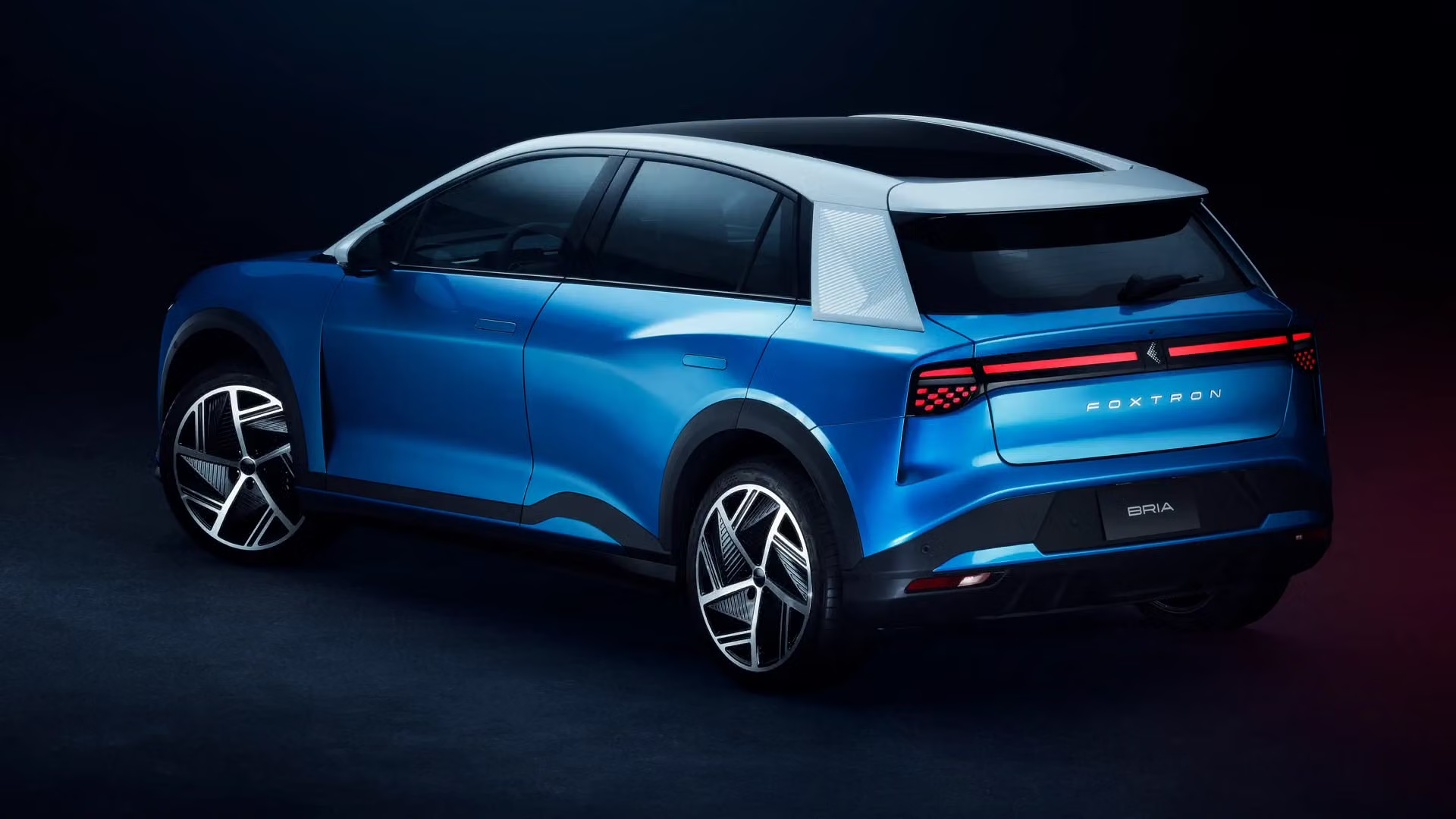
The new EV is not related to the gasoline-powered ASX currently sold in Australia. Instead, it is based on the Foxtron Bria, an electric vehicle developed in Taiwan by Foxtron, the automotive arm of electronics manufacturer Foxconn.
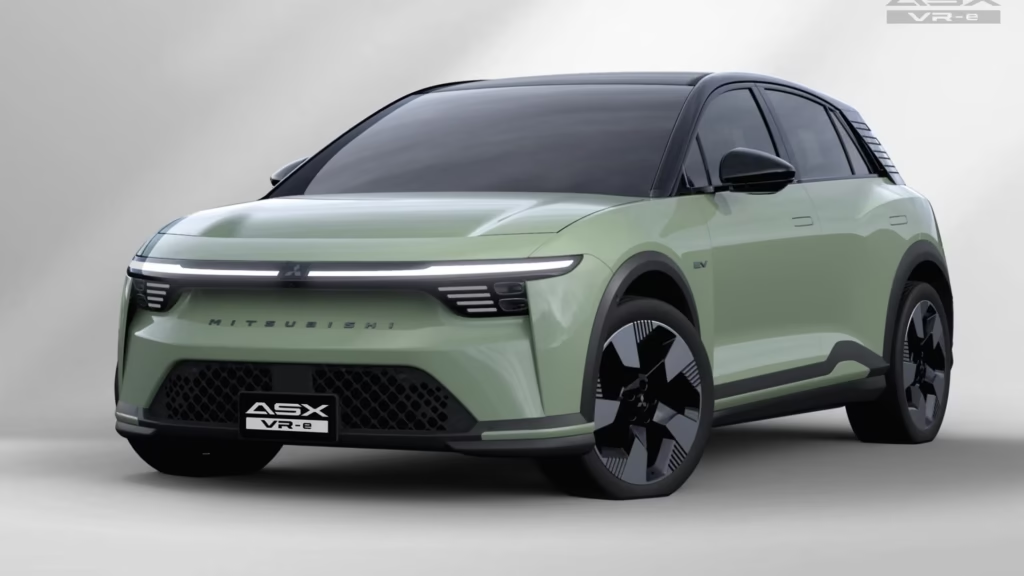
Mitsubishi has carried out local testing and development for Australia and New Zealand, while also giving the vehicle its own exterior and interior details.
The ASX VR-e name combines two familiar Mitsubishi badges. ASX stands for Active Sports Crossover, while VR-e takes inspiration from the VR-4 designation previously used on performance models such as the Galant VR-4.
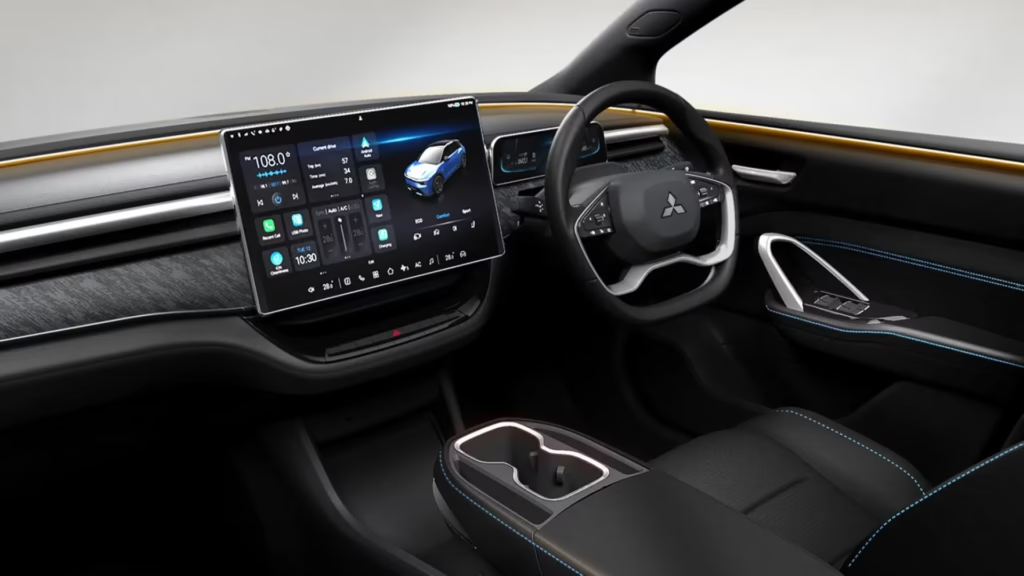
Four variants are planned for Australia, namely LS, Aspire, Exceed and GSR.
Mitsubishi has so far released only limited technical information for the ASX VR-e, but the Foxtron Bria on which it is based is offered with rear-wheel-drive and all-wheel-drive configurations.
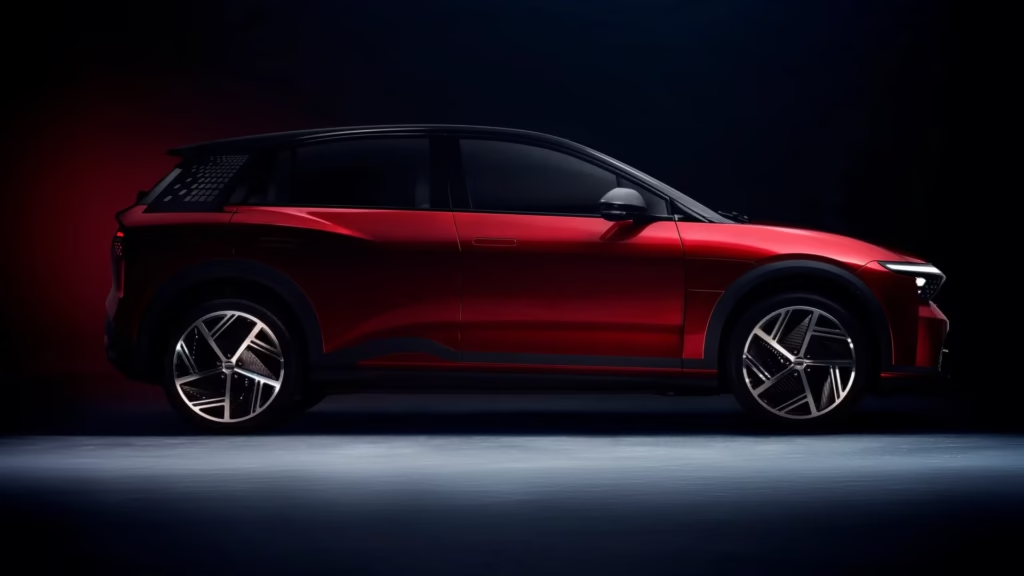
The rear-wheel-drive version uses a single electric motor producing 171 kW, or about 229 hp, and can accelerate from zero to 100 km/h in 6.8 seconds. The dual-motor all-wheel-drive version develops 298 kW, or about 400 hp, and cuts the sprint to 3.9 seconds.
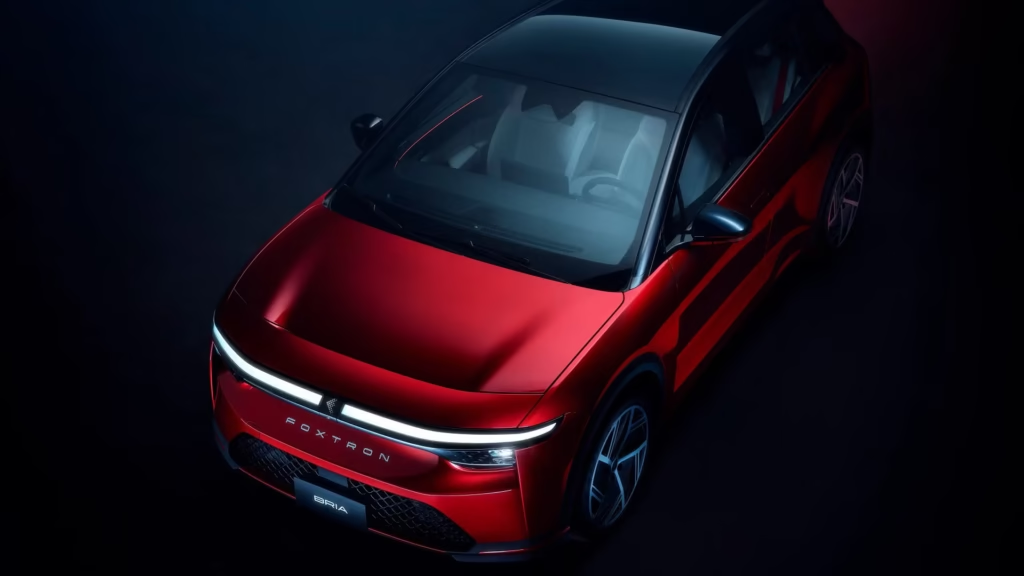
Both versions use a 57.5-kWh lithium iron phosphate battery. The Bria is rated at up to 516 km of range under the NEDC test cycle for the rear-wheel-drive model, while the all-wheel-drive version is rated at 466 km.
Estimated WLTP figures are lower at around 430 km and 400 km, respectively. DC fast charging is rated at up to 134 kW, with a 10 to 80 percent charge said to take about 30 minutes.
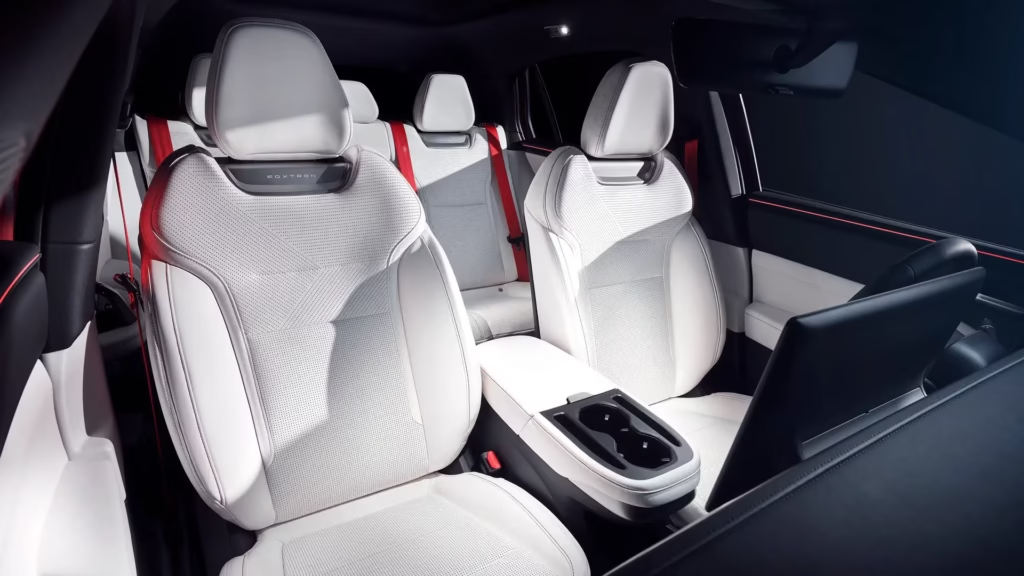
The ASX VR-e measures 4,315 mm long, 1,885 mm wide and 1,535 mm tall, with a 2,800-mm wheelbase. Its dimensions place it in the small crossover and hatchback class.
Changes from the Foxtron version include Mitsubishi badging, revised daytime running lights, different alloy wheels and interior trim. The vehicle also uses an S-duct through the front fascia and active grille shutters to help reduce aerodynamic drag.
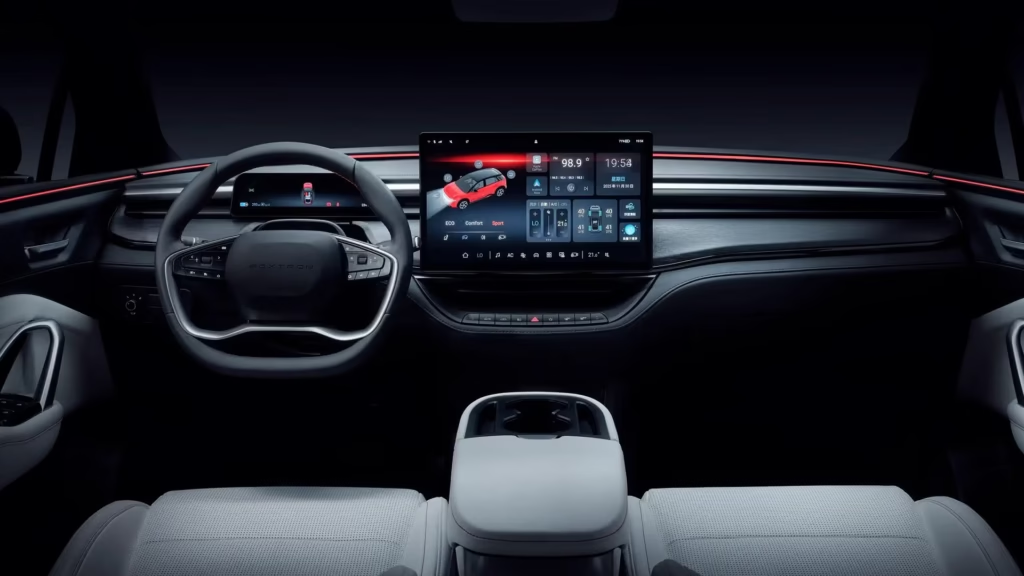
Expected equipment includes a 15.6-inch infotainment display, 9.2-inch digital instrument panel, power-adjustable front seats, a 360-degree camera, glass roof and ambient lighting.
Mitsubishi Motors Australia CEO Shunichi Kihara described the ASX VR-e as the brand’s first battery-electric vehicle in Australia since the i-MiEV and part of Mitsubishi’s wider electrification plans under its Momentum 2030 strategy.
Pricing and final Australian specifications will be announced closer to its launch later this year.

EV
Lexus ES enters electric era
Lexus Philippines has introduced the all-new ES with two hybrid variants and the nameplate’s first battery-electric model, giving the executive sedan its broadest powertrain lineup to date.
The eighth-generation ES will be available as the ES 350h Executive, ES 350h Luxury and fully electric ES 350e. Retail sales are scheduled to begin in the third week of August.

Prices start at P4,108,000 for the ES 350h Executive, while the ES 350h Luxury costs P4,308,000. The ES 350e sits at the top of the range at P5,688,000.

The arrival of the electric variant is the biggest change to the lineup, although the new ES also adopts a larger body and a longer wheelbase. The added length gives rear passengers more space, an important improvement for a sedan often used with a chauffeur.

Its exterior follows Lexus’ latest design direction, with a cleaner front section and a low, wide stance. The spindle shape remains visible in the bodywork, while the lighting and other graphic elements create a more modern interpretation of the familiar ES profile.

Both ES 350h variants use a 2.5-liter gasoline-electric hybrid system producing 247 PS. The setup is designed to deliver smoother power and lower fuel consumption without requiring external charging.

The ES 350e uses a front-mounted electric motor with an output of 224 PS. Lexus Philippines lists its battery capacity at 74.69 kWh, giving the ES its first fully electric drivetrain since the nameplate was introduced in 1989.

Cabin technology includes a 14-inch touchscreen with wireless Apple CarPlay and Android Auto. The new ES also uses Arene, Toyota Motor Corp.’s vehicle software platform that supports more than 200 functions across the car.

Equipment varies by model. The ES 350h Executive comes with a Back Guide Monitor, while the ES 350h Luxury and ES 350e receive a Panoramic View Monitor for a wider view of the vehicle’s surroundings.

Rear-seat comfort remains a priority, particularly in the Luxury and electric variants. Available features include reclining rear seats, an ottoman and controls that allow passengers to adjust their seating position and cabin settings.

The all-new ES also receives the latest Lexus Safety System+, which combines driver-assistance features intended to reduce the risk of a collision and support the driver in different road conditions.

Lexus Philippines President Masando Hashimoto said the new ES reflects the company’s direction as it gives customers a choice between hybrid and fully electric power.

The expanded lineup allows long-time ES buyers to remain with the familiar self-charging hybrid system, while the ES 350e provides a new option for customers ready to move to a battery-electric luxury sedan.
Cars
VinFast lowers ride-hailing entry cost with Rentapasada
VinFast Philippines and Green GSM are giving aspiring ride-hailing drivers a lower-cost route into business through Rentapasada, an electric vehicle rental program that requires an initial registration payment of ₱5,000.

The remaining deposit and transport network vehicle service registration fees may be paid gradually through deductions from the driver’s daily earnings. This reduces the amount needed at the start, which is often one of the largest barriers for Filipinos who want to enter the ride-hailing business.
The program turns the vehicle into an income-generating asset without requiring the driver to purchase it immediately. It also offers a possible route to ownership once the operator has established a steady business.

That approach reflects the importance of small enterprises to the local economy. Government data for 2023 showed that micro, small and medium enterprises accounted for 99.63 percent of registered establishments and nearly 67 percent of employment in the country.
Starting a transport business, however, requires far more capital than opening many other small ventures. A driver normally needs to cover the vehicle down payment, registration, insurance, maintenance and other operating expenses before accepting the first passenger.
Rentapasada replaces much of that initial expense with a fixed rental arrangement. Drivers may choose between the Herio Green at ₱1,050 per day and the seven-seat Limo Green at ₱1,350 per day.

VinFast said participating drivers retain 90 percent of their earnings during the first year and 85 percent in the second and third years. These earnings remain subject to the applicable daily rental and other charges under the program.
The rental agreement runs for five years and may be extended by another three. Drivers also have the option to buy the vehicle based on its residual value, allowing them to move from renting to owning instead of remaining under a recurring lease.
Using an electric vehicle can further reduce the cost of keeping a ride-hailing unit on the road. VinFast estimates that a Herio Green driven for 3,500 kilometers a month would consume about ₱5,600 worth of electricity based on standard residential charging rates.
The company compared this with a gasoline crossover covering the same distance and consuming about 238 liters of fuel, equivalent to an estimated monthly expense of ₱15,500. Based on those assumptions, the difference could reach more than ₱237,000 over two years.
For the larger Limo Green, VinFast placed the estimated two-year total cost of ownership at ₱1.37 million, compared with ₱1.53 million for a gasoline-powered MPV. That translates to potential savings of more than ₱162,000. Actual expenses will depend on charging rates, mileage, fuel prices and vehicle use.
Rentapasada drivers may also benefit from the number-coding exemption granted to electric vehicles under the Electric Vehicle Industry Development Act. The law provides the exemption for eight years from its effectivity in 2022, including similar schemes implemented by the Metropolitan Manila Development Authority and local governments. Republic Act 11697
While applicants still have to meet the program’s eligibility and registration requirements, the arrangement gives aspiring operators another way to enter ride-hailing without taking on the full cost of a vehicle at the beginning.
Interested drivers may obtain the complete requirements and application details through the official channels of VinFast Philippines and Green GSM Philippines.
Cars
GAC’s MPV MVPs
GAC Philippines has introduced three multi-purpose vehicles that cover practical family transport, premium hybrid travel and executive mobility.
The new GAC MPV Family consists of the all-new GN6, E8 HEV and GN8 PHEV Executive. Prices start at P1.298 million, while introductory offers are available for reservations made until 31 August 2026.
The seven-seat GN6 serves as the entry model. Its 1.5-liter turbocharged gasoline engine produces 176.7 PS and 270 Nm, paired with a seven-speed wet dual-clutch transmission.

A 2,810 mm wheelbase helps provide space across all three rows while keeping the vehicle manageable in urban areas. The GN6 has a 190 mm center aisle and 324 liters of luggage capacity with every seat in use. Folding the third row into the floor increases capacity to 1,100 liters.

Cabin equipment includes a 10.25-inch digital instrument display, a 14.6-inch touchscreen with Apple CarPlay and Android Auto, and dual-zone automatic climate control with rear controls.

Its safety package includes six airbags, electronic stability control and a 360-degree camera. Adaptive cruise control, lane keeping assist and automatic emergency braking are also fitted.
The E8 HEV occupies the middle of the range with a hybrid powertrain and a more passenger-focused cabin.

Its 2.0-liter engine develops 140 PS and 180 Nm, while the electric motor delivers 182 PS and 300 Nm. A two-speed Dedicated Hybrid Transmission manages the system. GAC claims a driving range of more than 1,000 kilometers from the 60-liter tank and a WLTC fuel consumption rating of 5.58 liters per 100 kilometers.
A low 375 mm step-in height makes access easier. The cabin offers up to 18 seating configurations, while the second-row Zero Gravity seats have powered leg rests, ventilation and massage functions.

Third-row Magic Storage seats can fold beneath the floor, increasing cargo capacity from 345 liters to 1,917 liters. Other equipment includes power-sliding doors, dual sunroofs, wireless phone charging and a 14.6-inch touchscreen.
Sitting at the top is the GN8 PHEV Executive, a full-size seven-seat model designed for chauffeured and premium family travel.

The plug-in hybrid combines a 2.0-liter turbocharged Miller-cycle engine with an electric motor for a total output of 373 hp and 630 Nm.
Its 25.5 kWh lithium iron phosphate battery provides up to 120 kilometers of electric range under NEDC testing. Total driving range reaches 1,038 kilometers. DC fast charging can raise the battery level from 30 to 80 percent in about 45 minutes.

Second-row captain’s chairs have powered leg rests, position memory, heating, ventilation and massage functions. The GN8 PHEV Executive also receives tri-zone climate control, soundproof glass, a 16-speaker audio system and a starlight panoramic roof.

The GN6 carries a regular price of P1.298 million and an introductory price of P1.198 million.
E8 HEV prices are P1.858 million for the GL and P1.998 million for the GX. Their introductory prices are P1.778 million and P1.918 million, respectively.
The GN8 PHEV Executive is priced at P3.488 million, with a P3.338-million introductory offer.
Reservations are now accepted at GAC dealerships nationwide.